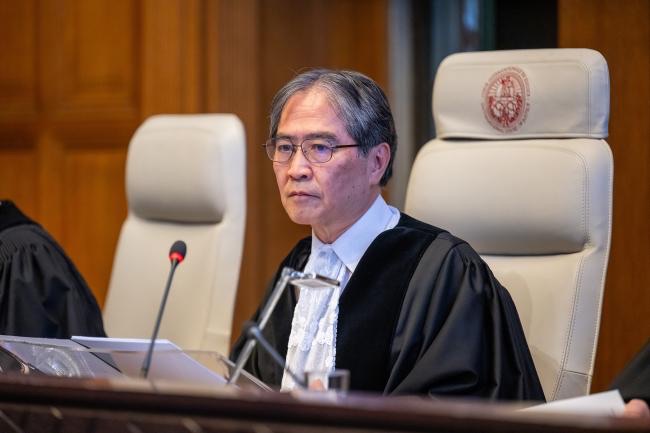
The President of the International Court of Justice (ICJ), Judge Iwasawa Yuji, has highlighted the Court’s growing caseload and reaffirmed the protection of workers’ right to strike under an International Labour Organization convention during an address to the 81st session of the United Nations General Assembly on 29 October 2026.
According to his address, the Court currently has 24 pending contentious cases, maintaining a record-high caseload. The disputes concern issues including territorial sovereignty, maritime boundaries, human rights, economic relations and treaty interpretation.
Among the Court’s key decisions during the reporting period was its 21 May 2026 Advisory Opinion on the right to strike under the ILO’s Freedom of Association and Protection of the Right to Organise Convention, 1948 (Convention No. 87). The Court concluded that the right to strike is protected under the Convention, although it did not determine the precise scope or conditions governing its exercise.
The Court also permitted Guatemala to intervene as a non-party in a sovereignty dispute between Belize and Honduras concerning the Sapodilla Cayes, allowing Guatemala to present its views on its claimed legal interests in the disputed maritime features.
In another decision, the Court found Russia’s counter-claims against Ukraine admissible in proceedings concerning alleged violations of the Genocide Convention. This procedural decision did not determine whether Ukraine had committed the alleged violations.
Judge Iwasawa also announced amendments to the Court’s rules governing documentary evidence. The changes, which take effect on 1 February 2027, require documents relied upon as evidence to be annexed to written pleadings or otherwise submitted in accordance with the Court’s rules.
The President’s address comes as the ICJ marks its 80th anniversary, reaffirming its role as the United Nations’ principal judicial organ in resolving legal disputes between states and providing advisory opinions on questions of international law.